Title
Mathematics and Hope: Levers of Innovation
Mathematics and Hope: Levers of Innovation
Pi Day Event — 14 March — 2026
Auditório da Biblioteca da Faculdade de Ciências da Universidade do Porto
Video recording of the session: https://youtube.com/live/u-JdclMNwf4?feature=share
Video recording of the round table: https://youtu.be/dg0tPNLabMc
Pictures of the event are accessible here: LinkedIn, Facebook, Instagram
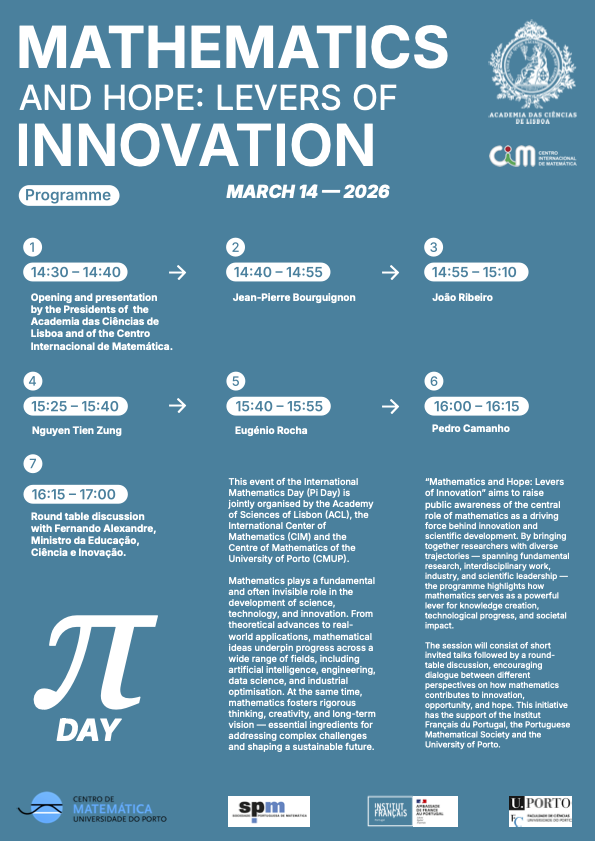
On the occasion of International Mathematics Day (Pi Day), the Academy of Sciences of Lisbon (ACL), the Centro Internacional de Matemática (CIM), and the Centre of Mathematics of the University of Porto (CMUP) jointly organise the event “Mathematics and Hope: Levers of Innovation”.
Mathematics plays a fundamental and often invisible role in the development of science, technology, and innovation. From theoretical advances to real-world applications, mathematical ideas underpin progress across a wide range of fields, including artificial intelligence, engineering, data science, and industrial optimisation. At the same time, mathematics fosters rigorous thinking, creativity, and long-term vision — essential ingredients for addressing complex challenges and shaping a sustainable future.
This event aims to raise public awareness of the central role of mathematics as a driving force behind innovation and scientific development. By bringing together researchers with diverse trajectories — spanning fundamental research, interdisciplinary work, industry, and scientific leadership — the programme highlights how mathematics serves as a powerful lever for knowledge creation, technological progress, and societal impact.
The session will consist of short invited talks followed by a round-table discussion, encouraging dialogue between different perspectives on how mathematics contributes to innovation, opportunity, and hope. This initiative has the support of the Institut Français du Portugal and the University of Porto.
Registration is mandatory and can be completed here. For logistical purposes, we kindly ask participants to register by 12 March.
Schedule
14:30 – 14:40
Opening and presentation of the event Presidents of the Academy of Sciences of Lisbon and of the Centro Internacional de Matemática
14:40 – 14:55 — Jean-Pierre Bourguignon
15:00 – 15:15 — João Ribeiro
15:20 – 15:35 — Nguyen Tien Zung
15:40 – 15:55 — Eugénio Rocha
16:00 – 16:15 — Pedro Camanho
16:20 – 17:00 — Round table discussion with all speakers and
Fernando Alexandre, Ministro da Educação, Ciência e Inovação.
____________________
Programme
Jean-Pierre Bourguignon
Tile: Mathematics and Hope, a pertinent coupling to address the many challenges we face
João Ribeiro
Tile: Rethinking Proofs
Nguyen Tien Zung
Tile: Mathematics in the age of AI
Eugénio Rocha
Tile: How Deep and Cross-Disciplinary Knowledge Catalyses Industrial Innovation: Real-World Examples
Pedro Camanho
Tile: Mathematics, Engineering Science and Art as enablers of hope
____________________
About the speakers
Jean-Pierre Bourguignon is a French mathematician whose work in differential geometry has had a lasting influence on the field. Trained at the École Polytechnique and Paris Diderot University, where he completed his PhD under Marcel Berger, he has combined deep scientific contributions with exceptional leadership in mathematics. He served as Director of the Institut des Hautes Études Scientifiques (IHÉS) for nearly two decades. He was the second President of the European Mathematical Society and later he became President of European Research Council. Widely recognised for his role in promoting mathematical excellence and long-term scientific vision, he has received several international distinctions and is an honorary or foreign member of multiple academies and learned societies.
João Ribeiro is an Assistant Professor in the Department of Mathematics at Instituto Superior Técnico (ULisboa) and a researcher at the Instituto de Telecomunicações. His academic path bridges mathematics and computer science, with training in applied mathematics, computer science, and a PhD from Imperial College London. His research focuses on coding theory, cryptography, information theory, and pseudorandomness, areas where deep mathematical ideas underpin modern digital security and communication. After postdoctoral work at Carnegie Mellon University and research stays at several leading international institutions, he was recently awarded an ERC Starting Grant, highlighting the innovative potential of mathematically driven research in theoretical computer science.
Nguyen Tien Zung is a mathematician internationally recognised for his contributions to symplectic topology, integrable Hamiltonian systems, and Poisson geometry. His work has clarified the geometric and topological structure of dynamical systems with singularities, emphasising the central role of symmetry and torus actions. After a successful academic career, including positions in France and Asia, he founded Torus AI in 2019, where he serves as CEO and scientific director. Through Torus AI, he applies mathematical thinking to artificial intelligence, signal processing, and generative models, while actively promoting an ethical and impact-driven vision of technology. His trajectory exemplifies how deep mathematical insight can drive innovation beyond academia.
Eugénio Rocha is an Associate Professor of Mathematics at the University of Aveiro and the current President of the Portuguese Mathematical Society. With academic training in artificial intelligence, mathematics, and nonlinear control theory, his work spans both theoretical and applied mathematics. He has published extensively in areas such as differential equations, optimisation, control theory, and mathematical modelling, with applications ranging from biology and epidemiology to engineering, economics, and education. Alongside his academic activity, he has played a central role in coordinating multidisciplinary teams in large-scale projects related to manufacturing, logistics, data science, and machine learning, illustrating how mathematics serves as a bridge between theory, computation, and real-world innovation.
Pedro Camanho is a Full Professor of Mechanical Engineering at the University of Porto and an internationally recognised expert in the mechanics of advanced composite materials. He obtained his PhD from Imperial College London and has led influential research on deformation, fracture, and multiscale modelling of lightweight composite structures for aerospace and engineering applications. His work relies heavily on mathematical modelling and computational mechanics and has been successfully transferred to industry, with methods implemented in widely used engineering software. A former leader of major research institutions and programmes, he has received numerous international distinctions, including a recent ERC Advanced Grant, in the cutting-edge of technological innovation.
_______________________